

本公司其它产品
品牌名称:
Product Introduction
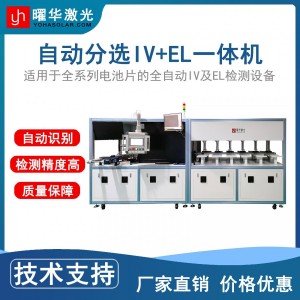
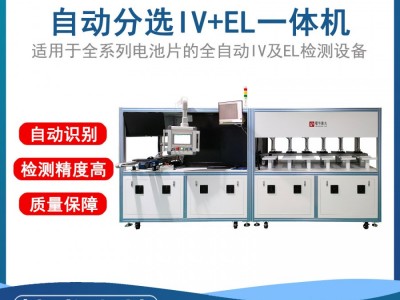
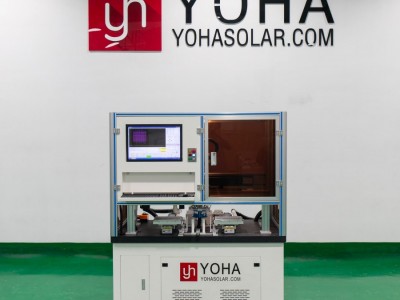
The Multi-grade Automatic Solar Cell EL+IV Sorting Integrated Machine is a highly integrated key equipment for solar cell production. It can fully automatically complete solar cell loading/unloading, transmission and positioning, electroluminescence (EL) defect detection (identifying microcracks, grid breaks, contamination, etc.), and current-voltage (IV) characteristic testing (measuring core electrical performance parameters such as efficiency, power, open-circuit voltage, and short-circuit current) on a single device. Based on preset multi-grade standards (e.g., efficiency, power, color, appearance grade), it automatically sorts and classifies solar cells. This equipment significantly improves the efficiency, accuracy, and consistency of cell testing and sorting, reduces manual intervention and fragmentation rate, and serves as a core automated device to ensure cell quality and meet module matching requirements.
Product Features
Integration: Combines EL detection, IV testing, and automatic sorting functions in one machine.
Automation: Automates loading/unloading, transmission, testing, and sorting, reducing manual intervention.
Dual Detection:
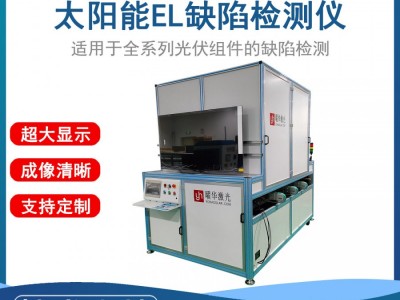
EL Detection: Non-destructive optical testing to identify internal defects (microcracks, grid breaks, fragments, contamination, process abnormalities, etc.).
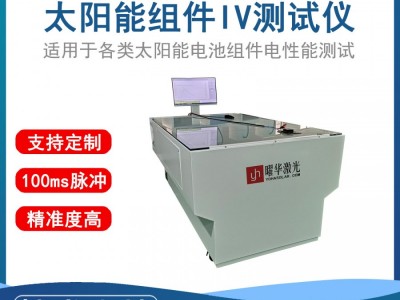
IV Testing: Measures key electrical performance parameters (Eff, Pmpp, Voc, Isc, FF, etc.).
Multi-grade Sorting: Sets multiple refined grading standards based on comprehensive EL results (appearance grade, defect type) and IV test results (efficiency, power grade) for high-precision classification.
High-speed Sorting: Enables high-speed testing and sorting (usually up to thousands of pieces per hour) with reliable and consistent results.
Core Value: Improves solar cell production efficiency and quality control levels, laying a foundation for subsequent module string welding and power matching.
Technical Parameters
| Item | Specification |
|---|---|
| Model | YHZD-ELIV |
| Solar Cell Specifications | Compatible with monocrystalline, polycrystalline, PERC, HJT, TOPCon solar cells, etc. |
| Camera Pixels | 5 million pixels |
| Camera Type | Custom high-definition industrial camera |
| Testing Direction | Vertically downward |
| Light Source | Complies with IEC 60904-9:2020 standard |
| Irradiance Instability | ≤2% |
| Irradiance Uniformity | ≤2% |
| Single Flash Pulse | 10ms |
| Capacity | 2000~5000 pieces/hour |
| Fragmentation Rate | ≤0.05% (Grade A+ cells) |
| Sensitivity | Capable of detecting cracks with width < 0.03mm |
| Loading Method | Automatic loading and unloading |
| Effective Test Area | 230*230mm |
| Sorting Bins | 8 sorting bins (optional) |
| Function Expansion | Support for additional AOI/PL detection functions |
Product Applications
Solar Cell Manufacturing Plants: The primary application field, used for quality control and performance grading in the later stages of the solar cell production process.
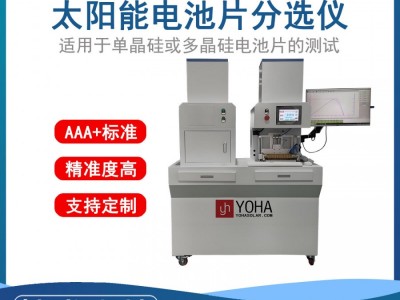
Solar Cell Performance Grading: Core application! Uses IV testing to measure electrical performance parameters (efficiency, power, etc.) of each cell, and automatically sorts cells into different performance grades according to preset refined grades (e.g., 0.1% efficiency difference per grade).
Solar Cell Defect Detection and Sorting: Core application! Uses EL detection to quickly and non-destructively identify cells with internal defects (such as microcracks, grid breaks, contamination, poor craftsmanship, etc.) like "X-rays", automatically rejecting unqualified products or classifying them by appearance grade.
Pre-module Production Matching: Ensures that cells sent to the module string welding process have highly consistent electrical performance (same grade) and qualified appearance (no severe defects), which is a key prerequisite for manufacturing high-quality, high-power, and high-reliability solar modules.
Improves Module Power and Yield: Prevents low-efficiency cells from reducing the power output of the entire string; eliminates defective cells with hidden risks (such as microcracks) to avoid hot spot formation in modules, reduce module failure risks, and improve long-term reliability.
Enables Automated Production Lines: As a key equipment at the end of solar cell manufacturing, it integrates loading/unloading, EL detection, IV testing, and automatic sorting functions, realizing full-process automation from testing to sorting and significantly improving production efficiency.
Reduces Production Costs: Reduces the need for manual inspection and sorting, saving labor costs; automated operations minimize cell fragmentation losses during handling; automatic grading optimizes cell value and improves module output benefits.
Precautions
Voltage Attention
The equipment involves high voltage (for IV testing). Operators and maintenance personnel must strictly follow operating procedures and wear protective equipment.
Ensure reliable grounding of the equipment to prevent electric shock risks.
Non-professionals are prohibited from opening electrical cabinets or adjusting laser sources without authorization.
Environmental Guarantee
The equipment must operate in a clean environment with constant temperature and humidity (usually 23±2°C, humidity <60%, dust-free). Environmental fluctuations will seriously affect IV testing accuracy and EL image quality.
Avoid direct strong light (especially interference with EL imaging) and vibration sources.
Calibration and Accuracy Maintenance
IV Testing Unit: Regular calibration (as required by the manufacturer, e.g., per shift, daily) with standard solar cells is mandatory to ensure the accuracy of electrical parameter measurements such as power and efficiency. This is the core basis for grading!
EL Detection Unit: Regularly clean lenses, calibrate light source uniformity and camera focus to ensure clarity and consistency of defect identification.
Material and Operation Specifications
Ensure that the specifications (size, thickness) of loaded cells meet the equipment design requirements.
Standardize loading/unloading operations to avoid artificial collision-induced fragmentation or introduction of new defects.
Use carrier tools (flower baskets, trays) specified by the equipment to ensure accurate positioning.
Key Daily Maintenance
Cleanliness! Cleanliness! Cleanliness! Regularly remove dust, fragments, and oxides from transmission rails, suction cups, probes, lenses, and sensors (probe oxidation can cause poor contact and inaccurate IV testing).
Lubricate moving parts as required by the manual.
Timely clean sorting bins to prevent fragmentation or shutdown caused by stacking and overflow.
Software and Data
Regularly back up grading rules, test parameters, and equipment operation logs.
After software upgrades or parameter modifications, verify the accuracy of test results and grading.
Pay attention to equipment alarm information and handle abnormalities promptly.
Probe Maintenance
IV test probes are key consumables. Regularly inspect for wear, clean, or replace them to ensure good contact with cell main grids. Poor contact is one of the main sources of IV testing errors.
Equipment Abnormality Handling
In case of abnormal fluctuations in test results, increased grading error rate, sudden rise in fragmentation rate, abnormal noise, or alarms, shut down the equipment immediately for inspection and contact professional maintenance personnel. Do not disassemble core components without authorization.

-
面议
立即询价 -

面议
立即询价 -
面议
立即询价


