

本公司其它产品
品牌名称:
Product Introduction
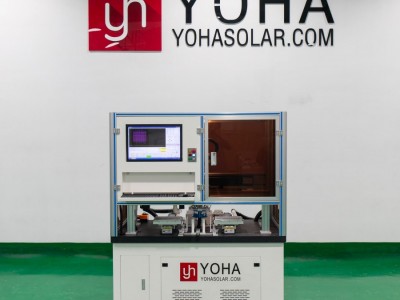
The Manual Solar Cell EL+IV Integrated Machine is a benchtop device integrating Electroluminescence (EL) defect detection and Current-Voltage (IV) characteristic testing functions. Exclusively designed for laboratories, R&D institutions or small-batch production environments, it is used to quickly complete quality evaluation and performance analysis of single solar cells.
Product Features
Integrated Dual Functions: A single device can perform two key tests for solar cell performance and quality detection.
Manual Operation: Operators need to manually place the tested solar cell on the probe station/object stage of the test area, and manually control the probes or pressure plate to ensure good electrical contact with the cell electrodes.
IV Testing: The device applies simulated sunlight (usually via pulsed or steady-state light source) to the solar cell and measures its response under different voltage/current conditions to generate an I-V curve, thus obtaining key parameters such as open-circuit voltage (Voc), short-circuit current (Isc), maximum power point (Pmax), fill factor (FF) and conversion efficiency (η).
EL Testing: Under darkroom conditions (the device is usually built with a light-shielding structure), a forward bias current is applied to the solar cell to make it emit near-infrared light by itself. A built-in high-sensitivity camera of the device captures the luminescence to generate an EL image, which clearly displays internal defects and process issues of the solar cell such as microcracks, grid breaks, fragments, black cores, black spots, sintering defects, shunt resistance and material inhomogeneity.
Compact and Easy to Operate: The all-in-one design saves space and simplifies the operation process. After the test, the device software provides both IV parameter reports and intuitive EL defect images, facilitating rapid analysis of solar cell quality and performance.
Technical Parameters
| Item | Specification |
|---|---|
| Model | YHCT-ELIV |
| Solar Cell Types | Compatible with monocrystalline, polycrystalline cells, PERC, HJT, TOPCon, etc. |
| Camera Resolution | 5 Megapixels |
| Camera Type | Customized high-definition industrial camera |
| Sensitivity | Capable of detecting cracks with width < 0.03mm |
| Testing Direction | Vertically downward |
| Light Source | Complies with IEC60904-9:2020 standard |
| Irradiance | 1000W/㎡ |
| Irradiance Instability | ≤2% |
| Irradiance Uniformity | ≤2% |
| Single Flash Pulse Width | 100ms |
| Loading Method | Manual loading and unloading |
| Effective Test Area | 230*230mm |
Product Applications
PV R&D and Process Optimization: Evaluate the performance and defects of new cell materials/structures, optimize key processes such as texturing, diffusion, passivation, coating, sintering and printing, and conduct failure mechanism research.
PV Teaching and Experiments: Provide a practical platform for universities and vocational education, intuitively demonstrating the working principle, performance parameters, common defects and their impacts of solar cells.
Production Quality Control and Incoming Material Inspection: Serve small and medium-sized cell/module manufacturers for sampling/100% inspection of trial production batches and high-value solar cells, defect screening and performance verification of supplier incoming materials, and rapid troubleshooting of production line process anomalies.
Third-Party Testing and Certification: Provide independent and standard EL defect detection and IV performance calibration services for solar cells to testing and certification institutions, for sample analysis or dispute arbitration.
Module After-Sales and Failure Analysis: Locate problematic solar cells in failed modules, analyze the causes of their internal defects (EL) and performance degradation (IV), and guide rework or improvement.
Precautions
Reliable Grounding: Ensure the equipment power supply is well grounded, and wear insulating gloves during operation to prevent electric shock.
Careful Handling of Solar Cells: Solar cell edges are sharp and fragile; wear cut-resistant gloves to handle with care, and clean up fragments in a timely manner to prevent scratches.
Avoid Direct View of the Light Source: Do not look directly at the high-intensity pulsed or steady-state light source used for IV testing to prevent eye damage.
Gentle Operation to Prevent Damage: Operate probes or pressure plates gently to avoid damaging the equipment or crushing solar cells due to excessive force; keep hands away from moving parts when the equipment is in operation.
Solar Cell Placement: When placing solar cells manually, ensure they are flat and centered, and the electrode direction strictly corresponds to the probe position.
Ensure Reliable Electrical Contact: Operate carefully to make the probes/pressure plate form stable and low-resistance contact with solar cell electrodes; poor contact is the main cause of inaccurate IV test results.
Maintain Cleanliness: Keep the equipment table, object stage, probe tips, solar cells themselves, and EL camera lens/observation window clean and free of dust, fingerprints and oil stains.
Complete Light Shading for EL Testing: Before conducting EL testing, confirm that the equipment's light shield is completely closed and there is no light leakage inside.
Correct Parameter Setting: Accurately set IV (light intensity, scanning range, speed) and EL (bias current, exposure time) test parameters according to solar cell types (e.g., PERC, TOPCon, HJT, IBC) and specifications; incorrect settings may render results invalid or damage solar cells.
Recommended Test Sequence: IV testing is usually performed first, followed by EL testing that requires power on.
Regular Cleaning and Maintenance: Frequently clean probe tips (with anhydrous ethanol), the object stage, the inside of the light shield and the EL camera lens (operate carefully with special tools).
Probe Inspection and Replacement: Regularly check probes for wear, bending or oxidation, and replace them in a timely manner to ensure good contact.
Regular Light Source Calibration (IV): Calibrate the light intensity of the IV test light source to the standard value (e.g., 1000 W/m²) as recommended by the manufacturer or based on usage frequency to ensure the accuracy of parameters such as efficiency.
Regular Camera Calibration (EL): Regularly check the focus and uniformity of the EL camera, and perform calibration (e.g., flat field correction) when necessary to ensure image quality.
System Calibration Execution: Conduct periodic calibration of the equipment's overall electrical measurement accuracy and spatial positioning as required by the instruction manual.
Check Contact First for IV Result Interpretation: When analyzing IV data, first check whether the curve is smooth without steps; anomalies are usually caused by contact problems.
Pay Attention to Ambient Temperature: Keep the laboratory temperature relatively stable (recommended 25±2°C); temperature changes affect solar cell performance (especially Voc).
Professional Experience Required for EL Image Interpretation: EL image analysis requires professional knowledge to distinguish real defects (microcracks, grid breaks, black cores, etc.) from image artifacts (noise, uneven illumination).
Monitor Light Source Service Life: The IV test light source (xenon lamp/LED) has a limited service life; monitor light intensity attenuation and replace it in a timely manner.
Monitor Probe Service Life: Probes are consumables and should be replaced regularly according to usage intensity.
Clarify Equipment Limitations: This equipment is suitable for manual single-sheet testing with limited speed; the resolution of EL detection determines the size of identifiable defects.
Trained Operators Only: Operators must receive sufficient training and pass qualification before operating the equipment.

-

面议
立即询价 -
面议
立即询价 -

面议
立即询价


